
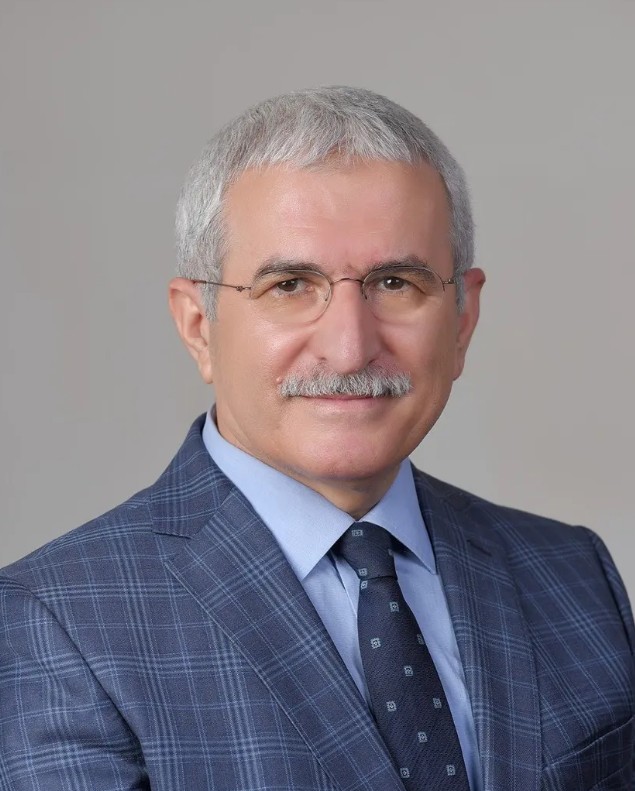
By Ibrahim Ozdemir, Muslim Environmentalist, Philosopher, and CMGT Board Member
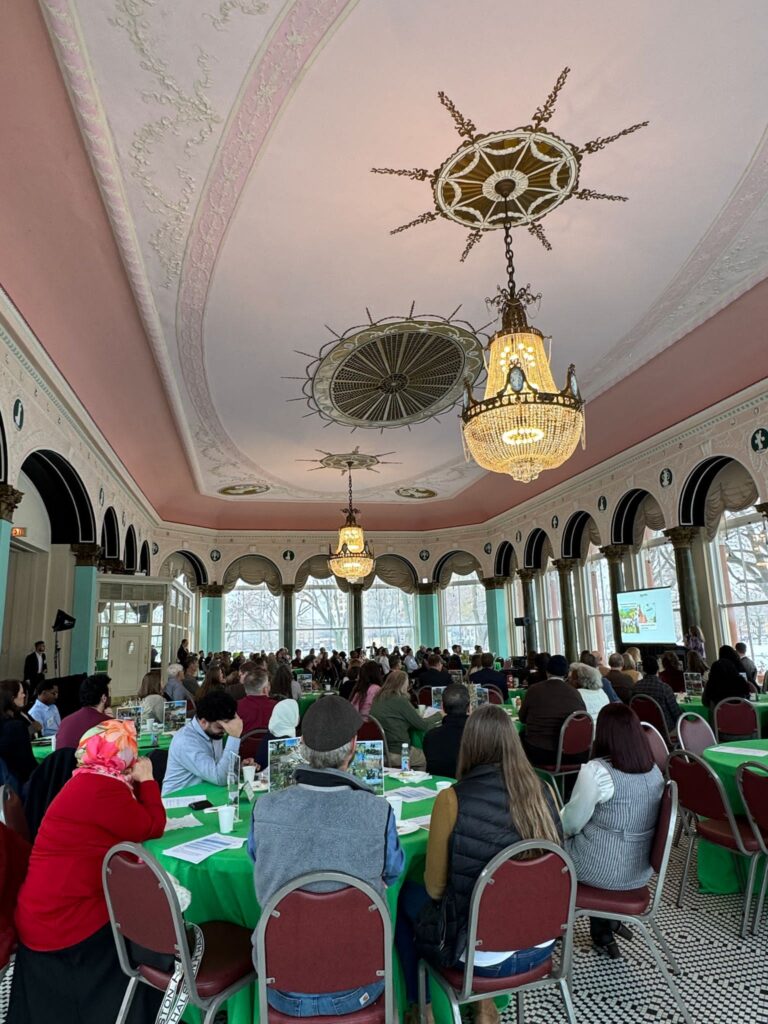
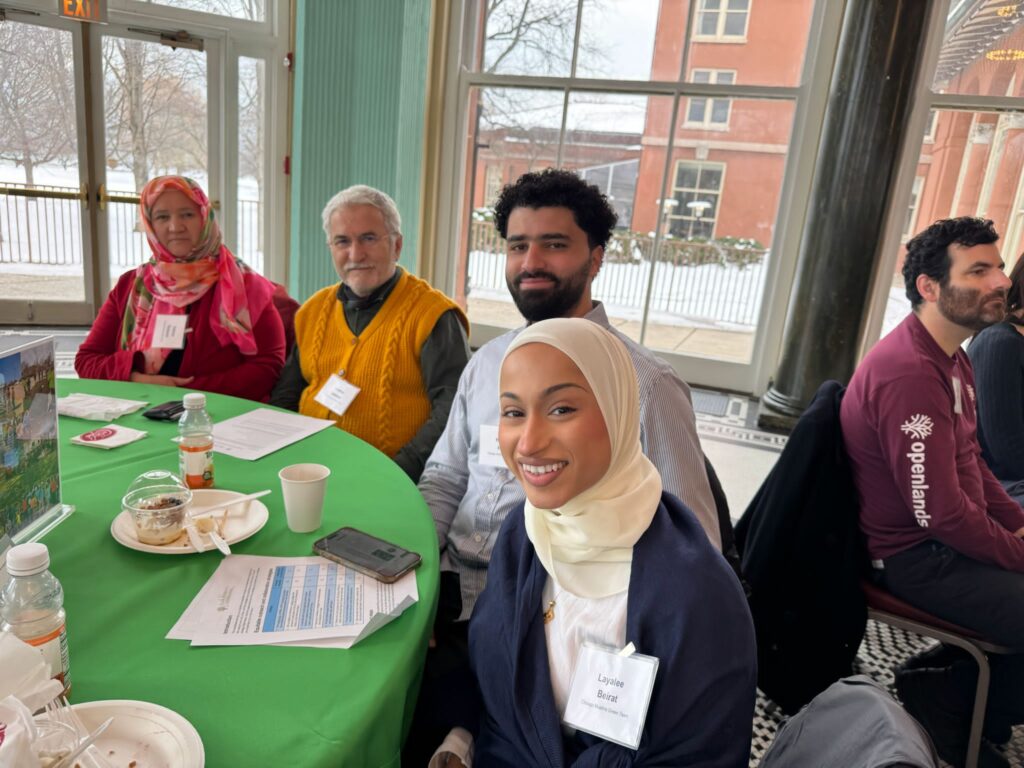
This morning, I attended a great breakfast hosted by the Chicago Region Tree Initiative at the South Shore Cultural Center. Our primary focus was caring for trees, as they are essential to both ecosystems and human life. We considered how trees clean out air, cool our cities, support biodiversity, and bring healing and beauty to our neighborhoods.
Dr. Christina Carmichael, founder and principal of Fair Forests Consulting, emphasized that we are entering a new era — one in which our care extends not only to humans but also to the trees in our neighborhoods. Every single tree matters.
The community-focused approach described in the shared questionnaire shows us that understanding a neighborhood today involves more than just demographic or social information — it requires listening to how resident perceive and value their natural environmental.
Questions like “What do you notice about the trees?”, “What concerns do you have?”, and “What would you like to see in the future?” show a growing awareness: trees are no longer background elements. They are active participants in our shared ecosystem.
As we discussed community engagement and environmental stewardship, I was reminded of a profound saying of the Prophet Muhammad (peace be upon him): “If the Final Hour comes while you have a sapling in your hand, and you are able to plant it, then plant it.”
This compelling teaching captures the core of hope, responsibility, and action –regardless of how overwhelming the uncertainty may seem. It reminds us that caring for the Earth is not just an ecological duty but also a moral and spiritual act. Even when facing ultimate judgement, one must pursue good deeds, growth, and future benefits, showing that hope and responsibility endure until the very end.
Today’s gathering — bringing together young people who traveled long distances on a snowy morning — deepened my belief that caring for trees is, in essence, caring for life itself. Their commitment, warmth, and curiosity confirmed that when we nurture a tree, we nurture our communities, ecosystem, and the future generations who will inherit this Earth.
CMGT Board Members attend the CRTI’s Annual Partner Recognition Celebration (12/6) at the Chicago Cultural Center
As a Muslim environmentalist, I have many scientific works, literary reflections, and spiritual texts on trees. Over the years, I have even classified all the Qur’anic verses and Prophetic sayings related to trees, a testament to how deeply our tradition honors the living world. Among the many writings I cherish, one that continues to move me is an essay by German Nobel laureate Herman Hesse.
As my wife and I head to a breakfast organized by the Chicago Region Tree Initiative this morning, Hesse’s timeless words in “On Trees” return to me with depth and meaning:
“For me, trees have always been the most penetrating preachers. I revere them when they live in tribes and families, in forests and groves. And even more I revere them when they stand alone.
They are like lonely persons.
Not like hermits who have stolen away out of some weakness, but like great, solitary men, like Beethoven and Nietzsche. In their highest boughs the world rustles, their roots rest in infinity…
Nothing is holier, nothing is more exemplary than a beautiful, strong tree. When a tree is cut down and reveals its naked death-wound to the sun, one can read its whole history in the luminous, inscribed disk of its trunk: in the rings of its years, its scars, all the struggle, all the suffering, all the sickness, all the happiness and prosperity stand truly written, the narrow years and the luxurious years, the attacks withstood, the storms endured. And every young farm boy knows that the hardest and noblest wood has the narrowest rings, that high on the mountains and in continuing danger the most indestructible, the strongest, the ideal trees grow.
Trees are sanctuaries.
Whoever knows how to speak to them, whoever knows how to listen to them, can learn the truth…
So, the tree rustles in the evening, when we stand uneasy before our own childish thoughts: Trees have long thoughts, long-breathing and restful, just as they have longer lives than ours. But when we have learned how to listen to trees, then the brevity and the quickness and the childlike hastiness of our thoughts achieve an incomparable joy. Whoever has learned how to listen to trees no longer wants to be a tree. He wants to be nothing except what he is.
That is home.
That is happiness.“
Our our way home, I kept the flyer with me — determined to share its message with my neighbors. It felt more than a handout; it was a reminder that each of us has a role in caring for the trees, the land, and our community.
By passing it along, I hope to spark conversations, inspire small acts of care, and help cultivate a neighborhood where every tree and every person truly matters. And in doing so, I remind myself of the timeless wisdom in the Prophet’s saying: “If the Final Hour comes while you have a sapling in your hand, and you are able to plant it, then plant it.” A reminder that hope, stewardship, and responsibility start with even the tiniest act.